


To understand the symptoms of cervical osteochondrosis, it is useful to know a little about the anatomy of the neck.One of the largest blood vessels in the neck, the vertebral artery runs along the spine, carrying oxygen and vital nutrients to all parts of the brain.
Osteochondrosis is caused by an accompanying reaction in the vertebral body with deformations of the intervertebral discs and cartilage.
With this disease, degenerative changes occur in the disc, its height decreases and the physiological functions of the discs are lost.The result is instability and changes in the spinal joints.

As the disease progresses, the end plate of the vertebral body reacts and the curvature of the spine causes narrowing of the spinal canal.
In most cases, cervical osteochondrosis does not cause any symptoms at first.As the disease progresses, the space for the spinal cord, nerve roots and vertebral artery narrows.When these sensitive elements are compressed, only then the symptoms of cervical osteochondrosis begin to develop:
- pain and stiffness in the neck;
- regular dull, oppressive headache, aggravated by movement and not relieved by analgesics;
- numbness, tingling, or weakness in the arms or legs;
- lack of coordination;
- dizziness;
- ringing and noise in the ears;
- memory loss;
- emotional changes;
- Loss of bowel or bladder control.
For cervical osteochondrosis, depending on the cause and form of the disease, doctors recommend:
- non-steroidal anti-inflammatory drugs - reduce pain and eliminate inflammation;
- corticosteroids - prednisone helps relieve pain;
- muscle relaxants - cyclobenzaprine relieves muscle spasms in the neck;
- anticonvulsants - sometimes prescribed for numb pain due to damaged nerves;
- antidepressants;
- ointments - distracting and warming, anti-inflammatory and combined.
Physiotherapy
A physical therapist teaches patients exercises that lengthen and strengthen the neck and shoulder muscles.Stretching exercises, including the use of counterweights, widen the space within the spine and release the nerve roots.
Regular exercise and staying active speeds up the recovery process.
In especially severe cases, when the patient cannot perform physiotherapeutic procedures on his own, a gentle massage helps.It can be done at home and gives real results.
A massage mat, a whip, a chair, a rolling pin, a bamboo broom and a tape for self-massage - all these improvised means are used for the patient with cervical osteochondrosis, all symptoms and home treatment, massage.
The main principles of massage for cervical osteochondrosis:
- light effect, no force required;
- direction of movement from the spine;
- smoothness and softness of movements;
- massage with your fingers only.

Some people use massage cups, believing that it improves blood circulation.Before the procedure, the skin should be lubricated with massage oil or vaseline, and no more than seven minutes should pass after sticking the jar on the skin.
Massage therapists have been using honey for their treatments since ancient times.
The approximate principle is as follows: heat your neck with a heating pad for 15 minutes, then apply a spoonful of honey and gently massage your neck and shoulders until your hands start to stick to your body.
The honey should turn white and your skin will hurt a little.The neck heated in this way is covered with a film and wrapped with a woolen scarf.Only wash honey in the morning.
Folk remedies for the treatment of cervical osteochondrosis
You definitely cannot prescribe folk remedies - cervical osteochondrosis with its symptoms can be treated at home with the help of essential oils, herbs, oils, roots and poisons.They are combined with alcohols, iodine and turpentine, and quite effective anti-inflammatory and warming agents are obtained for both external and internal use.
Herbal treatment of cervical osteochondrosis
Celery remedy.Grate the celery root with the finest grater and squeeze out the juice.For cervical osteochondrosis, symptoms and home treatment, take one tablespoon of celery juice three times a day before meals.
A less concentrated version of the drug - add 100 ml of boiling water to 1 tablespoon of juice, leave for several hours and take one tablespoon of the solution an hour before meals 4 times a day.
Instead of juice, you can use the root itself - pour 3 grams of root in 0.5 liters of boiling water, leave for several hours until it cools completely, and drink 20 ml before each meal.
Bay leaf medicine.In an enamel bowl, pour 12 grams of bay leaves with 300 ml of cold water and boil for five minutes.Infuse for three hours, filter.
Drink the infusion in small sips between meals throughout the day.Drink the rest before going to bed.Continue to take the medicine for four days, take a break for a week and repeat the course.

Compresses
Burdock and horseradish leaves have proven themselves as compresses.They are boiled with hot water, applied to the damaged area and kept for several hours, wrapped with a cotton cloth.Repeat 10 times daily.Repeat 2-4 times a year.
Cervical osteochondrosis: is home treatment effective?
The effect of the complex treatment of osteochondrosis at home, if the methods are carried out correctly, will often be quite fast.
The condition of the spine improves, the intervertebral discs keep their integrity and shape longer.But there is one condition: the diagnosis of "cervical osteochondrosis" must be made by a qualified doctor.
Methods of treatment (including non-traditional ones) are also discussed with him.
Cervical osteochondrosis with symptoms can be treated at home with rubbing, compresses, physiotherapy or herbal remedies, but it is strictly forbidden to do apitherapy, acupuncture, spinal stretching and deep massage at home.These methods are used only under the supervision of a doctor.
After a week of treatment at home, the symptoms of osteochondrosis should decrease.If this does not happen, you need medical help, you may have to undergo an emergency operation, and you will forget about cervical osteochondrosis for a long time!
Before proceeding directly to the discussion of home treatment of osteochondrosis of the cervical spine, you need to understand in detail how the pathology develops.Self-treatment can be carried out when a person clearly understands why the cervical spine is affected.
Cervical osteochondrosis: symptoms
Cervical osteochondrosis is characterized by dystrophic and degenerative processes in the cartilage and bone tissue of the intervertebral discs and the vertebrae themselves.
Cervical osteochondrosis is the most common after lumbar.Its specificity is that in most cases the vertebral artery is also involved in the degeneration process.

Different symptoms in cervical osteochondrosis are caused by different factors.Due to the multitude of symptoms, only a specialist can make a final diagnosis and recommend the right therapy at home.
However, there are a number of signs that allow people to begin to suspect cervical osteochondrosis.These symptoms include:
- neck pain;
- fairly severe and long-lasting headaches;
- dizziness, nausea, unsteady gait;
- decreased sensitivity in the shoulder girdle and arms;
- irritation, tears, insomnia.
Treatment of cervical osteochondrosis at home: recommendations and contraindications
Now more and more vertebrologists recommend combining home treatment with medication.
The presence of osteochondrosis of the cervical spine implies its mandatory treatment, which should begin immediately after the diagnosis by a neurologist or vertebrologist.
Typically, drugs, massage courses, physiotherapy, acupuncture and several other forms of therapy are prescribed.
The specificity of cervical osteochondrosis allows combining commonly prescribed therapy with home treatment.Home remedies in no way exclude conventional treatments.
Treatment at home is necessary:
- relieve pain;
- improve metabolic processes in the affected area;
- strengthen shoulder girdle and neck muscles;
- normalize sleep, eliminate negative feelings;
- improve blood supply to the brain.
Home treatment of cervical osteochondrosis, attractive in itself, can make the patient's life much easier.It is very important that you don't have to leave your usual environment to achieve all the listed goals.
The following are usually prescribed during home treatment:
- massage and self-massage;
- use of additional devices;
- folk remedies;
- a set of special exercises;
- physiotherapy at home.

Massage and self-massage
The effectiveness of home massage and self-massage often exceeds the effectiveness of drug treatment for cervical osteochondrosis.Any mechanical manipulation allows you to relax the muscles of the neck and shoulder girdle as much as possible.
As for the pain, it is almost completely eliminated.Massage and self-massage lead to an increase in metabolic processes in the cervical region, and the blood pressure level normalizes.
Only an experienced specialist, many of whom work from home, can successfully perform the procedures.
If it is not possible to pay for the services of a massage therapist, the self-massage technique for osteochondrosis of the cervical spine comes to the rescue.
The techniques are quite simple, but very effective.A few important rules must be followed.
First, the massage should be done only with your fingers.Secondly, the movements are carried out strictly in the peripheral direction from the spine.Third, the affected area should be applied very lightly without applying force.Movements should be very smooth.
Self-massage
Self-massage techniques include warming up, rubbing and stroking the back of the head, back and side muscles of the neck.
The process is strictly carried out in a sitting position and you need to cross your legs.
The elbow of the arm on the side where this leg is located is placed on the thrown back leg.
Massage movements are performed with the fingers of the other hand.
Physiotherapy at home
Physiotherapy at home is rarely done.However, combined with general home and drug treatment, it has proven to be effective for cervical osteochondrosis.
The main obstacle for patients who want to perform physiotherapeutic procedures at home is always the lack of necessary equipment.
Many physical therapists can make home visits to perform treatments.
At home, ultraviolet radiation, vibration effects, electrotherapy, shock wave techniques, interference therapy, diadynamic therapy, as well as electrical neurostimulation performed directly through the skin are performed.
Read more about physiotherapeutic procedures for cervical osteochondrosis.
Most patients buy the equipment themselves.
However, it is not recommended due to the high costs, as well as the fact that most procedures cannot be performed alone.
Moreover, physical therapy alone is not enough to completely get rid of cervical osteochondrosis or its symptoms.
Exercises against cervical osteochondrosis
Physical therapy or exercise therapy is a mandatory element of general therapy for osteochondrosis of the cervical spine.
Almost all exercises can be done at home.
The basis of gymnastics is circular movements of the head, bringing the chin as close to the chest as possible, throwing the head towards the back surface.
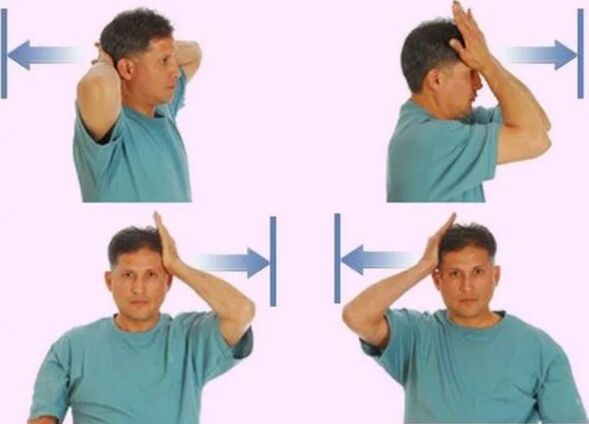
Each dynamic exercise should constantly alternate with relaxation and static muscle tension in the cervical region.This is done with the help of your palm while sitting or lying down.
Therapeutic exercise at home involves the involvement of not only the neck muscles, but also the muscles of the shoulders and arms in physical activity.Circular movements of the joints help to relieve pathological muscle tension.
It is very important to perform each exercise very smoothly.It is very important not to rush.Each exercise should be repeated the recommended number of times - usually around five.
Exercises for cervical osteochondrosis
At the same time, while eliminating unpleasant symptoms, there are several exercises that can prevent the further development of the pathology.The following four actions are often recommended:
- Sitting at the table, you need to keep your back very straight and even.The elbows are placed on the table, the ears should be pressed against the palms.The head bends towards the shoulder and the hand goes against it.The head is kept in this position for about ten seconds.The exercise is repeated ten times on average.The purpose of the exercise is to strengthen the lateral neck muscles.It is very important to strengthen the muscles evenly.For this, the number of repetitions in each direction should be the same.
- You should sit with your back straight at the table.The hand is placed on the table with the elbow.Your forehead should rest on your elbow.You should put your forehead in your palm and press for ten seconds.The exercise should be repeated up to ten times.
- You need to lie on your back.You need to press the back of your head to the floor for five to six seconds.It strengthens muscles and relieves nervous tension.
- This exercise is performed on the stomach.Unlike the previous one, this one uses the forehead, which has to be pressed to the ground for five to six seconds.This is an excellent exercise for developing muscles and strengthening joints.
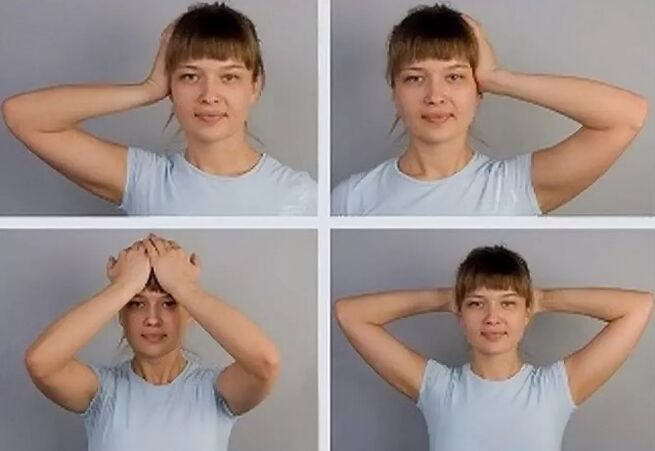
The listed exercises represent the so-called gold standard.For home therapy, they are very simple, but extremely effective.